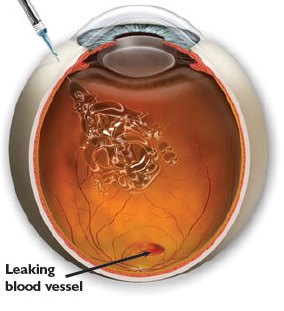
Intravitreal Injection
An intravitreal injection is a shot of medicine into the eye. The inside of the eye is filled with a jelly-like fluid (vitreous). During this procedure, your health care provider (usually an ophthalmologist) injects medicine into the vitreous, near the retina at the back of the eye.
Conditions Treated with Intravitreal Injections:
- Macular degeneration (specifically Wet Age-related Macular Degeneration)
- Diabetic Retinopathy
- Retinal Vein Occlusions
Generally, any retinal condition caused by new blood vessel growth and fluid leakage may benefit from injections.
How it Works:
When the anti-VEGF drugs are injected into the eye, they stop the growth of new blood vessels. These new blood vessels are bad because they grow abnormally and bleed into the eye. In some retinal diseases, the blood vessel growth is controlled by a growth factor called VEGF. Anti-VEGF medicines interrupt this process, which should slow the growth and any associated swelling. Steroids are only used in patients that don’t respond to anti-VEGF drugs.