REFRACTIVE ERRORS
What are refractive errors?
Refractive errors are vision problems caused by the way the eye focuses light, leading to blurred or distorted vision. These errors include myopia (nearsightedness), hyperopia (farsightedness), astigmatism, and presbyopia.
What is myopia?
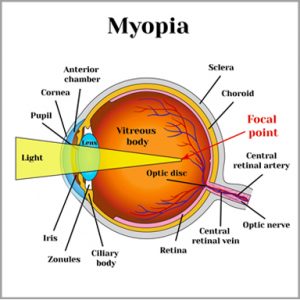
Myopia, also known as nearsightedness, is a common refractive error in which distant objects appear blurry while close objects can be seen clearly. This is caused by the eye being too long or the cornea being too curved, causing light to focus in front of the retina instead of directly on it. Myopia can be corrected with glasses, contact lenses, or refractive surgery.
What is hypermetropia?
Hypermetropia, also known as farsightedness, is a refractive error in which close objects appear blurry while distant objects can be seen clearly. This occurs when the eye is too short or the cornea is too flat, causing light to focus behind the retina instead of directly on it. Hypermetropia can be corrected with glasses, contact lenses, or refractive surgery.
What is the correct way to use glasses for refractive errors?
To properly use glasses for refractive errors, it is important to:
- Wear them as prescribed: Wear glasses as often as recommended by your eye doctor and replace them when they become scratched or damaged.
- Keep them clean: Clean the lenses regularly with lens cleaning solution or water and a microfiber cloth to avoid smudges and scratches.
- Store them properly: Store glasses in a case when not in use to protect them from damage.
- Adjust them properly: Glasses should sit comfortably on your nose and ears, and the lenses should be centered in front of your eyes.
- Use the right glasses for the right task: Some tasks, such as reading, may require special glasses with different prescriptions than your regular glasses.
It is also important to have regular eye exams to ensure your glasses prescription is up-to-date and to detect any changes in your vision

What are the common myths about refractive errors
- Glasses will weaken your eyes: False. Glasses or contact lenses help correct refractive errors and improve vision.
- Only older people need glasses: False. Refractive errors can occur at any age, and some children may also need glasses.
- Reading in dim light causes nearsightedness: False. The cause of nearsightedness is not completely understood, but it is likely due to a combination of genetic and environmental factors.
- Wearing someone else’s glasses is safe: False. Glasses are prescribed specifically for an individual’s eyes and wearing someone else’s glasses can cause eye strain, headaches, and other problems.
- Contact lenses are not safe: False. When used properly and cared for properly, contact lenses are safe for most people.
- You only need to have an eye exam if you have symptoms: False. Regular eye exams can detect eye problems early, even if there are no symptoms.
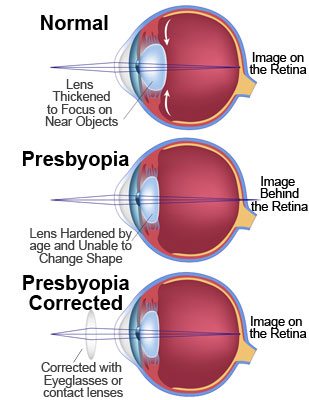
What is presbyopia?
Presbyopia is a normal age-related change in which the eyes have difficulty focusing on close objects, such as small print. It typically begins in the mid-40s and affects most people by their late 40s or early 50s. The cause of presbyopia is a decrease in the eye’s ability to change its focus to see close objects, due to a loss of flexibility in the lens. Presbyopia can be corrected with reading glasses, bifocal or multifocal lenses, or contact lenses.
What are progressive glasses?
Progressive glasses, also known as progressive lenses or multifocal lenses, are eyeglasses with lenses that have multiple prescription strengths in one lens. They provide a seamless progression of multiple lens powers for distance, intermediate, and near vision, eliminating the need for multiple pairs of glasses or bifocals. The different prescription powers are blended together in a gradual progression, allowing the wearer to see clearly at all distances without visible lines separating the different lens powers. Progressive glasses are a popular option for people who need correction for both near and far vision and want a more natural and aesthetically pleasing appearance.
Is it easy to get used to progressive glasses
Getting used to progressive glasses can take some time for some people, but the adaptation period varies from person to person. It can take anywhere from a few days to a few weeks to get used to the new glasses and the progressive lenses. Some people may experience visual distortions, headaches, or eye strain as they adjust to the new lenses.
To make the transition to progressive glasses easier, it is important to choose a reputable optometrist or optician and to have an accurate prescription and proper fitting of the glasses. It may also be helpful to take things slow and allow the eyes to gradually adjust to the new lenses over time. Some people may find that gradually increasing the amount of time they wear their progressive glasses each day can help them adjust more quickly.
In some cases, people may not be able to adjust to progressive lenses and may need to switch to another type of lens, such as bifocal or single-vision lenses. If a person is having difficulty adjusting to their new progressive glasses, they should speak with their eye doctor.